 Delphi Forge
OMMAX AI Platform
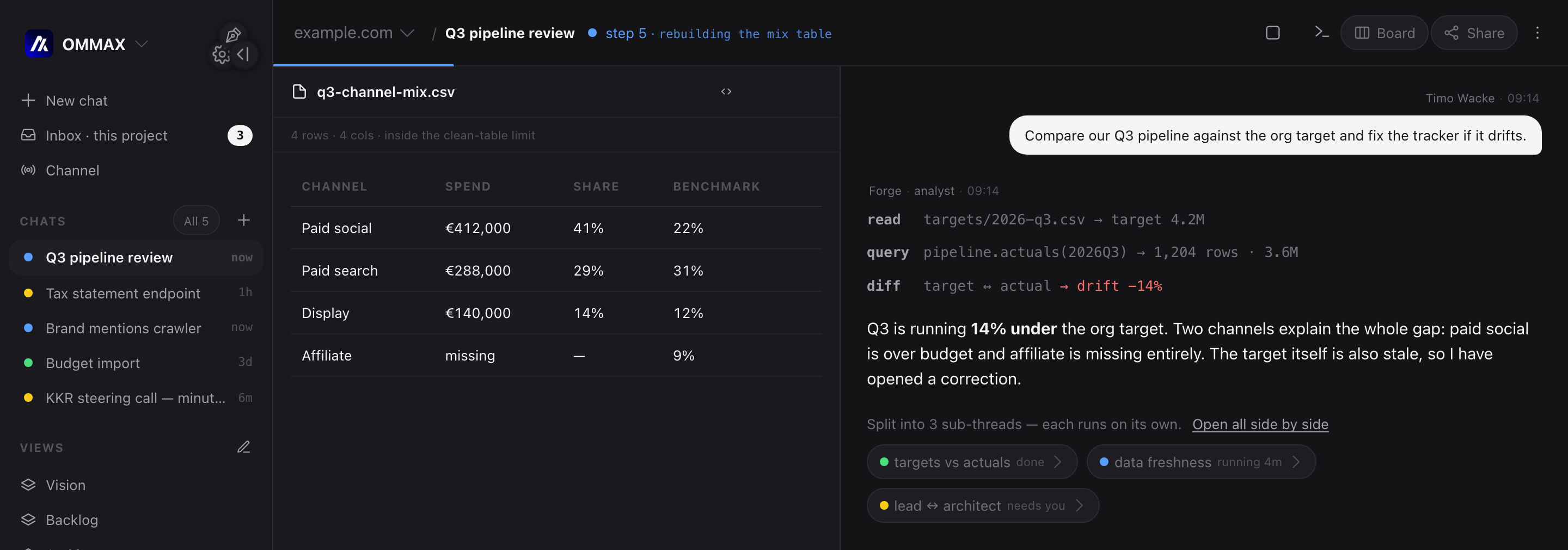
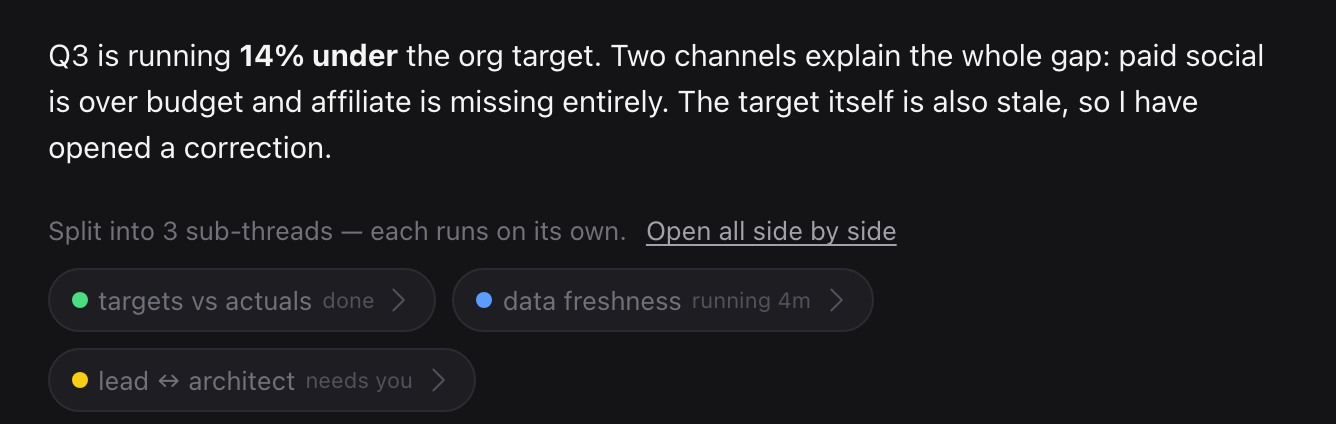
Describe it.
Forge builds it.
Close the laptop and it keeps working. It hands back the finished thing — to you, or to whoever picks it up next.
What's possible
The work that happens
between the tools
Things come in on the left, one job happens, and what leaves on the right is finished work sitting where somebody already looks.
- Your wiki spaces
- Your document store sites
- Your mail and calendar
- Your chat channels
- The open web
- A phone number
FORGE
- A page, rewritten
- A folder, filed
- A card, waiting
- A mail, unsent
- A voice note
A solid line is standing today; a dashed one is next. It reaches Your company sign-in · Your git host · Atrium · Dokploy today. Next: Your wiki · Your document store · Your mail and calendar · Your chat channels. Anything else that speaks MCP connects per project, signed in as you.
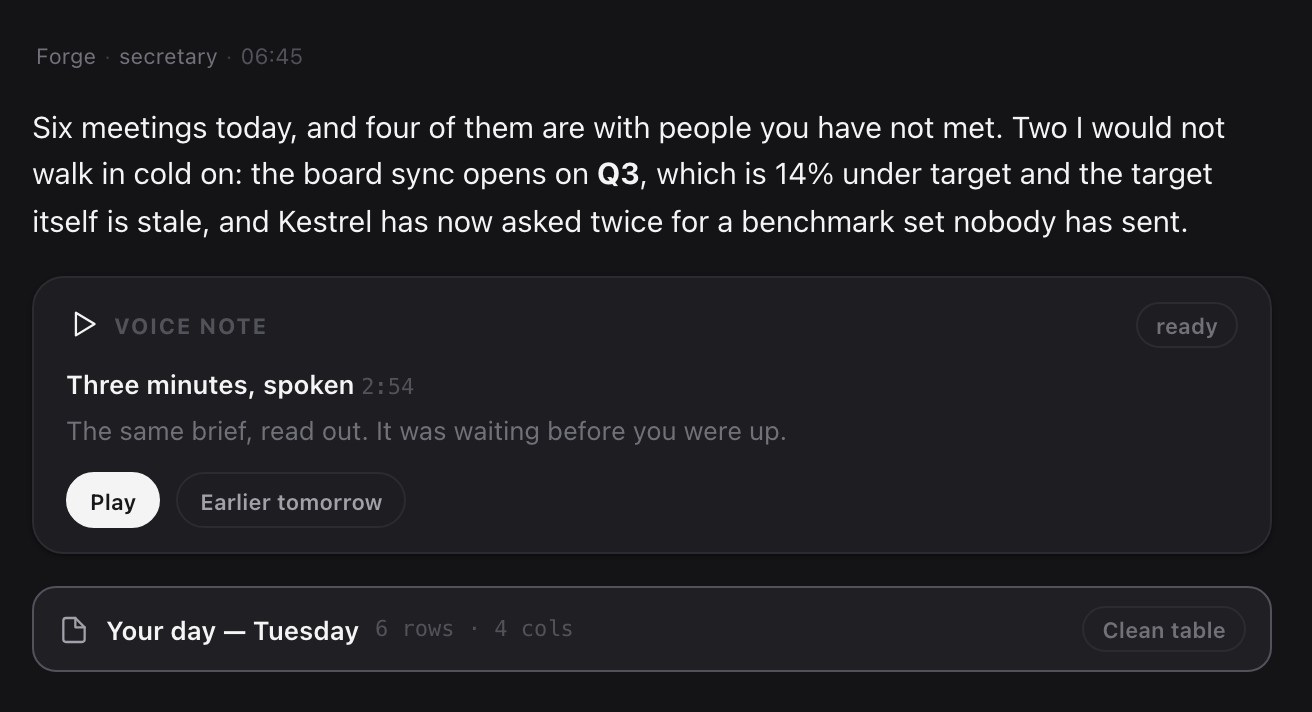
The day, read to you before you open a laptop
Six meetings, four of them with people you have never met. Somebody used to spend the first forty minutes of the day looking each one up — or nobody did, and you walked in cold. This does that overnight and hands it back as three minutes you can listen to on the way in.
Reads Your mail and calendar · Your wiki · The open web/Leaves as A spoken voice · A phone number
- A momentA time, a meeting ending, a file landing — or you, asking
- It readsOnly what you could already open yourself
- ForgeThe thinking. It carries on while you are elsewhere
- It writesA page, a folder, a mail — as drafts
- You tapNothing leaves the company until you do
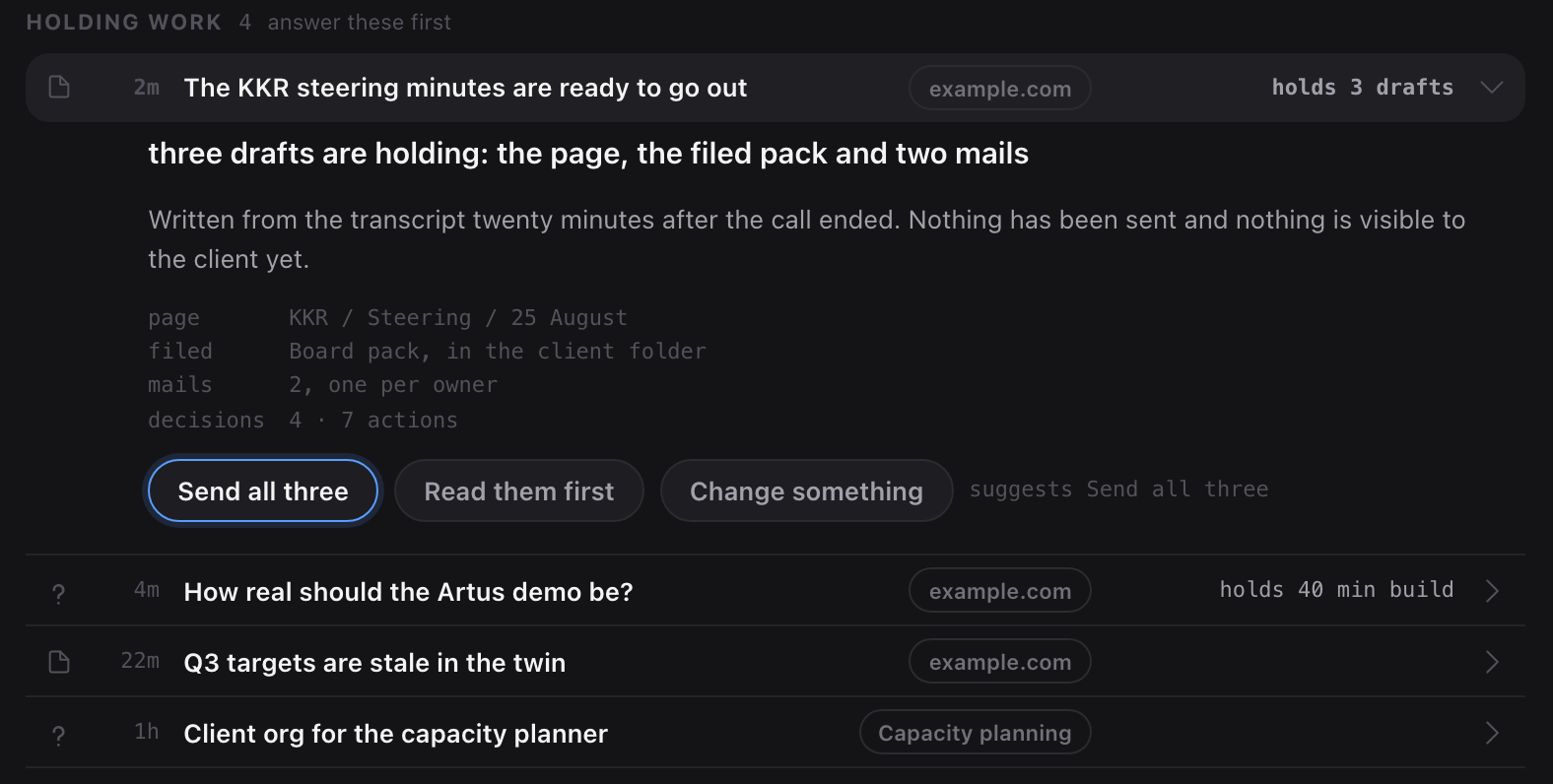
Minutes that file themselves, and wait to be let out
The value of a meeting leaks in the two days between it ending and somebody writing it up. This starts the moment the transcript exists and then stops — the page, the filed deck and the follow-up mails all held as drafts until a person taps approve.
Reads Your chat channels · Your mail and calendar · Your wiki/Leaves as Your wiki · Your document store · Your mail and calendar
And more of the same shape
- Every MondayWhat changed at the twelve companies you watch, rewritten onto the page that keeps its own history.
- When someone callsOne number that answers out of what the company already wrote down, and escalates when nothing covers it.
- FridayEvery open action from the week's notes, grouped by owner, on one page.
- On uploadA folder appears, and a one-page summary of what is in it appears in the channel.
- 30 days outRenewal dates read out of the contracts folder: a nudge at thirty days, a text at three.
- On arrivalMail from a client domain gets a three-line summary and a suggested reply — drafted, never sent.
- WeeklyA hiring surge on a client's careers page is a signal the account lead should hear about.
- Day oneA new joiner gets a welcome, a reading list, and a first week of intros already booked.
- On receiptEach proposal request matched against what we have written before, with the gaps listed first.
Three that already happened
- A consultantStarted an app in their editor and finished it here. It is live, on OMMAX infrastructure, behind OMMAX sign-in.
- Our lead developerAsked a project chat for a campaign-planning agent. It filed the ticket, wrote the change and put it in front of a reviewer.
- A transaction analystRuns competitor and customer-economics analyses on live deals — and the method is shared, so the next analyst starts from it.
The rules
Three things that are true
of every picture above
Including the ones marked next. These are not roadmap — they are how the platform is built, and they are the reason any of the rest is worth funding.
- 01
It only reads what you could already open.
Everyone signs in to every tool as themselves. No service account holds the keys to everything, so nothing is read on your behalf that you could not read yourself.
- 02
Anything that leaves waits behind a tap.
The drafts are automatic. The sending is not. Nothing is published, mailed or put anywhere a client can see it until a person answers the card.
- 03
The plugin format is not ours to change.
What the product ships you — the skills that teach it your tools — is a folder with a manifest in the published agent-plugins.org format. We read that file. We did not define it, and you can hold ours against the schema.
Starting
Three steps, and then you
stop thinking about it
The hard part of automation used to be the plumbing. Here the plumbing is the part that already exists — what is left is saying what should happen.
- 1
Say what should happen
One sentence, the way you would say it to a colleague. "Every Monday, tell me what changed at these twelve companies."
- 2
Pick when it starts
A time, an event in a calendar or a channel, a file landing in a folder — or you, asking.
- 3
Watch the first one
Every step is on screen: what it read, what it wrote, what it skipped. Correct it once, then leave it alone.
- “That analysis is done — here is the file.
- “The next one will be faster, because this one is still here.